
Best Red Gram Seeds
Red gram, also known as pigeon pea, is a widely cultivated and highly nutritious legume crop in India. It is valued for its protein-rich seeds and has significant economic importance.
At DesiKheti, we bring you premium-quality red gram seeds. We offer a wide collection of red gram seed varieties from top brands. Our extensive range ensures that you get the best red gram seeds suited to your specific farming needs.
Explore our red gram seed collection below, place your order online, and get seeds delivered directly to your location.
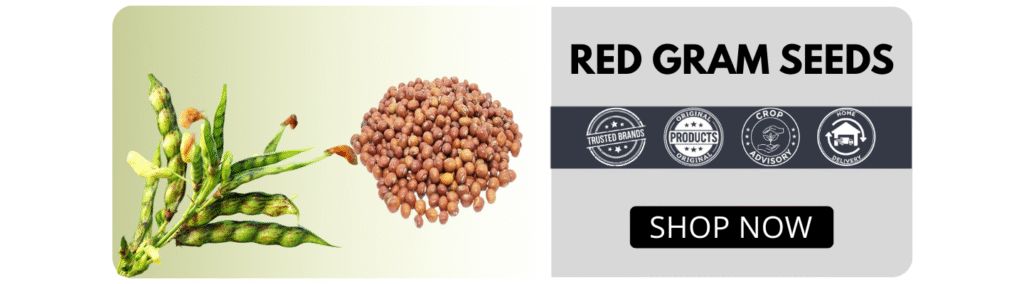
Red gram (Cajanus cajan) is commonly known as pigeon pea. It is a widely grown legume in India and other tropical regions. It belongs to the Fabaceae family, which also includes crops like chickpea, lentil, and soybean. Red gram is highly valued for its nutritional content, particularly its rich protein and essential minerals, making it a staple in many diets.
Role of Red Gram in Indian Cuisine
Red gram is widely consumed across India in various forms, primarily as a staple in dals, soups, and curries. Its seeds are often split and cooked to prepare traditional dishes like toor dal, sambhar, and various lentil-based gravies, providing a rich source of protein and essential nutrients.
Role of Red Gram in Global Cuisine
Globally, red gram (pigeon pea) is an important legume crop, especially in tropical and subtropical regions of Africa, Asia, and the Caribbean. It is widely used in stews, soups, and curries, and often forms a key component of vegetarian and vegan diets due to its high protein content. In countries like Kenya, Tanzania, and the Philippines, pigeon pea is used in traditional dishes such as stews, rice-based meals, and dal preparations. Red gram is also processed into split peas, flour, and canned products, making it versatile for both home cooking and commercial food industries worldwide.
Food Processing of Red Gram
Red gram (pigeon pea) is extensively used in the food processing industry to produce a variety of value-added products. Its seeds are commonly split and processed into dal, which is a staple in Indian households and widely exported. Red gram flour is used to prepare snacks, pancakes, and traditional dishes like dhokla and vadas.
In addition to these, red gram is processed into canned products, ready-to-cook dal mixes, and packaged lentils, which help extend shelf life, reduce wastage during peak harvests, and provide farmers with a consistent market. The versatility of red gram in processed foods makes it an important crop both for culinary purposes and the food processing industry.
Non-Culinary Uses of Red Gram
Red gram (pigeon pea) is not only a valuable food crop but also plays an important role in sustainable agriculture. One of its key benefits is nitrogen fixation, which improves soil fertility naturally. This makes red gram an excellent crop for crop rotation, as it enriches the soil for subsequent crops like cereals and vegetables.
Red Gram Farming
Red gram is a highly rewarding crop for farmers due to its adaptability, nutritional value, and consistent market demand. It can be cultivated in diverse soil types and climates, including semi-arid and rainfed regions, making it suitable for multiple cropping cycles in a year.
Why Red Gram Farming?
- Steady demand for red gram in both domestic consumption and food processing industries.
- Good returns even from small landholdings.
- Supports sustainable agriculture through nitrogen fixation, improving soil fertility for future crops.
- Strong market demand in pulses export and regional trading sectors.
Before starting red gram farming, it is essential to select the right variety based on climate, soil type, market demand, and farming purpose. Proper seed selection and sowing techniques can help ensure high germination, healthy plants, and better yields, maximizing profitability for farmers.
Popular Red Gram (Pigeon Pea) Types in India
Pusa 992
Pusa 992 (Cajanus cajan) was developed by the Indian Agricultural Research Institute (IARI), New Delhi. It is suitable for rainfed areas and produces medium-sized seeds.
LRG 30
LRG 30 (Cajanus cajan) is widely cultivated in Karnataka and Andhra Pradesh. It produces bold seeds and shows uniform growth with high pod formation.
BDN 2
BDN 2 (Cajanus cajan) is popular in Madhya Pradesh and Maharashtra. It is an early-maturing variety that produces medium-sized seeds.
LRG 52
LRG 52 (Cajanus cajan) is a popular red gram variety in Karnataka and Andhra Pradesh. It is an early-maturing variety that produces medium to bold seeds with good cooking quality.
Buy Red Gram Seeds from various brands at DesiKheti:
Daftari Red Gram Seeds | Kaveri Seeds Red Gram Seeds | Sai Krupa Seeds Red Gram Seeds | Sri Keerthi Seeds Red Gram Seeds
Popular Red Gram (Tur) Seed Varieties
At DesiKheti, you can buy red gram (tur) seeds online from top brands. We offer a wide range of premium-quality red gram seeds suitable for various farming needs. Red gram seed varieties from popular brands such as Daftari, Kaveri, Sai Krupa, and Sri Keerthi Seeds are available at DesiKheti. Explore our collection and buy the best red gram seeds online at DesiKheti for a good red gram crop.
Popular Red Gram Seed Varieties
Popular Daftari red gram seed varieties available at DesiKheti include Daftari-48 Red Gram Seeds and DPV-345 Red Gram Seeds.
Popular Kaveri red gram seed varieties available at DesiKheti include Sampada Red Gram Seeds.
Popular Sai Krupa red gram seed varieties available at DesiKheti include Dharani Red Gram Seeds.
Popular Sri Keerthi Seeds red gram seed varieties available at DesiKheti include LRG-52 Red Gram Seeds, ICPL-85063 Laxmi Red Gram Seeds, ICPL-87119 Asha Red Gram Seeds, and LRG-41 Red Gram Seeds.
Red Gram Seeds in Farming
Red gram seeds are small, round to oval, and reddish-brown in color, often with a smooth texture. They are obtained from mature pods of the red gram plant. Under suitable conditions, red gram seeds generally germinate within 7–12 days. Red gram seeds are usually sown directly in the field. Generally, around 2 to 4 kg of red gram seeds are sown per acre.
Importance of Choosing Quality Red Gram Seeds
Seeds play a vital role in red gram farming, as the success of the entire crop depends on their quality. For farmers, investing in high-quality red gram seeds is not just an expense but a smart decision that can lead to higher productivity, consistent yields, and better profitability.
Why Procure Red Gram Seeds from DesiKheti
At DesiKheti, we understand how crucial genuine seeds are for successful red gram farming. That’s why our collection features red gram seeds from trusted and reputed brands. Farmers can explore a wide range of popular red gram varieties suited for different regions, climates, and various other farming needs. Browse our red gram seed collection, choose the varieties you need, and get them delivered directly to your doorstep with just a few clicks.
Red Gram Seed Sowing Guide
Before sowing, it is important to check whether the red gram seeds have been pre-treated to protect against soil-borne diseases and pests. Red gram seeds are often treated to ensure better germination, healthy seedlings, and strong plant development.
If the seeds are not pre-treated, it is recommended to follow expert guidance for seed treatment.
Best Time to Sow Red Gram Seeds
The ideal time for sowing red gram (pigeon pea or tur) seeds depends on the region and the arrival of the monsoon. In India, red gram is mostly sown during the Kharif season, from June to July, coinciding with the start of the monsoon. In regions where the monsoon is delayed or erratic, sowing can be postponed until August. However, extremely late sowing should be avoided as it can reduce overall crop yield.
For the Rabi season, red gram seeds are typically sown between September and October. However, the exact sowing time varies based on the region and local climatic conditions. It is important to schedule sowing so that the flowering and pod formation stages of the crop do not coincide with heavy rainfall, as excessive moisture during these stages can adversely affect yield.
Method of Sowing Red Gram Seeds
The method for sowing red gram (pigeon pea or tur) seeds varies depending on factors such as soil type, season, and variety. Seeds of early-maturing red gram varieties are often sown on flatbeds or raised beds, while late-maturing varieties are generally sown in ridge-and-furrow systems. Red gram seeds can be sown either by line sowing or by broadcasting, with line sowing being preferred for better crop management.
Generally, a spacing of 60 × 10 cm for short-duration varieties and 75 × 20 cm for medium- to long-duration varieties is followed for red gram seeds. However, the exact spacing varies based on the region, method of sowing red gram seeds, variety, and various other factors. Red gram seeds are sown at a depth of 5–7 cm.
Red Gram Seeds in Different Indian Languages
- Telugu: కందుల విత్తనాలు (Kandula Viththanaalu)
- Hindi: अरहर के बीज (Arhar ke Beej)
- Bengali: টুয়ার বীজ (Tuwar Beej)
- Gujarati: તુવારના બીજ (Tuvarna Beej)
- Malayalam: തുവരപ്പരിപ്പ് വിത്തുകൾ (Thuvaraparippu Vithukal)
- Marathi: तूर बियाणे (Toor Biyane)
- Odia: ତୁଆର ବିଆ (Tuaar Bia)
- Punjabi: ਅਰਹਰ ਦੇ ਬੀਜ (Arhar de Beej)
- Tamil: துவரம் விதைகள் (Tuvaram Vithaigal)
- Kannada: ತೊಗರಿ ಬೀಜ (Togari Beeja)
- Konkani: तूर बियाणे (Toor Biyane)
- Assamese: টুৱাৰ বীজ (Tuwar Beej)
- Urdu: ارہر کے بیج (Arhar ke Beej)
- Kashmiri: ارہر ہُند دانہٕ (Arhar Hund Daaneh)
- Sanskrit: अडकि बीजानि (Aḍaki Bījāni)
Popular Red Gram Seed Research Centres in India
- Tamil Nadu Agricultural University (TNAU), Coimbatore
- ICAR-Indian Institute of Pulses Research (IIPR), Kanpur
